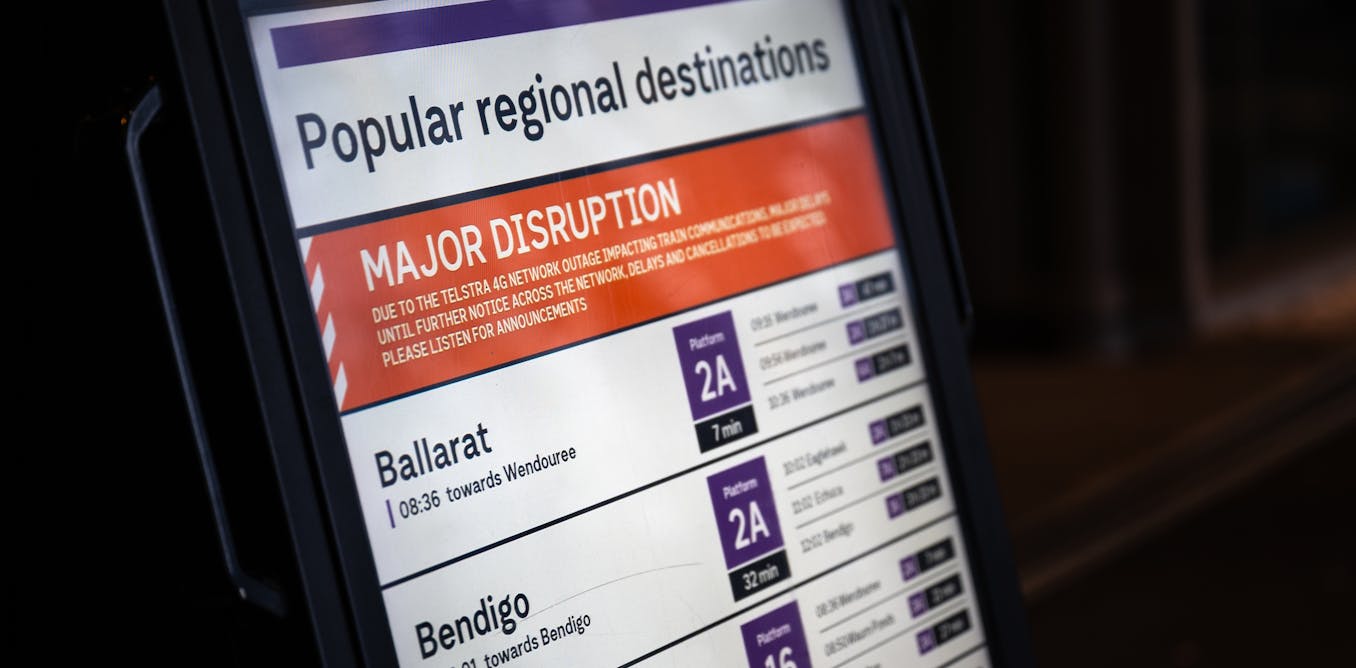
Australians woke up this morning to a major outage affecting Telstra, the largest telecommunications network in the country. But mobile phones weren’t the only thing knocked out of action.
Some EFTPOS payment services, taxi payment systems, electric vehicle charging platform Chargefox, and public transport ticketing in Canberra were all affected. There have been conflicting reports over whether Triple Zero calls were impacted, as they were in a recent Optus outage.
Read more:
How do Triple Zero calls actually work? A telecommunications expert explains
Most notably, train services were affected in Victoria and New South Wales. Victoria’s regional train system, V/Line, suspended services across all lines due to the national Telstra outage.
As of Wednesday mid-morning, there has been no estimated time for when trains will start running again, and limited coach replacements are available. With the outage having started about 4.30am, this threw the morning commute into chaos for many.
But how does a mobile network crash affect trains? Let’s look at the underlying tech connections.
How do trains use a mobile network?
Trains have roof-mounted antennae that connect them with control centres. Voice and data communication between trains and control centres takes place on frequency channels that are used in mobile networks.
Trains can use these channels to either “talk” to the control centre as required, or share real-time information such as the train’s location, speed, arrival times and so on. This ensures safe and reliable travel across the rail network.
Roof-mounted antennae on trains can also provide mobile phone services to on-board passengers. Train service providers can use this connectivity for specific purposes like retrieving and managing ticketing information, and also for providing passengers with access to the Internet.
Why can trains not go if the Telstra network is down?
If the mobile network is down, trains lose their connection and can’t send or receive traffic-related information. This includes any time-critical traffic alerts, such as delays, cancellations or other changes to the route.
Trains also often send diagnostic data through mobile networks – these are factors such as engine and braking performance.
All this means that while trains can technically still run (they used to before mobile networks were invented), this lack of mobile connectivity wouldn’t allow for a safe and secure journey.
The government-owned Australian Rail Track Corporation (ARTC), which manages more than 9,600km of rail tracks in New South Wales, Queensland, South Australia, Victoria and Western Australia, upgraded their train-to-network communications to 4G on the Telstra network in 2024. VicTrack, which runs V/Rail, also uses the Telstra network, and ARTC is one of its transport partners.
Therefore, any glitches in the Telstra network will make it extremely difficult to control train traffic on railways that rely on it. Most train networks would fall back on satellite systems, but they don’t provide the same service level as terrestrial mobile networks – notably, they have a slower speed.
Could there have been back-ups to prevent such an outage?
Because trains travel at fast speeds, using multiple networks would ensure continuous connectivity along the entire route.
Some areas on a route may only be served by one mobile service provider, in which case if that service provider is not available, that entire area will suffer from a loss of connectivity.
Financial feasibility concerns often affect decisions that ensure continuous mobile coverage, particularly in regional and rural areas. Satellite communication is often used as backup where mobile coverage is not present.
Train operators should be mindful of putting all their eggs in one basket when it comes to mobile network coverage.
Why did the Telstra network go down?
As the company still investigates the cause of the outage, Telstra’s acting chief executive Michael Ackland said at a press conference there was a timing issue with several nodes in the network. He said:
The time synchronisation in those nodes wasn’t working as it should. We don’t know why yet.
All the bits and pieces of a telecommunications network have to maintain time synchronisation – which means all devices across the network have the same accurate time.
Time synchronisation allows multiple devices to share information on wireless channels without affecting each others’ transmissions. Loss of time synchronisation may result in devices talking over each other, not being able to maintain mobile connectivity, and failure of authentication sequences (verifying users).
Ackland assured the media there was no sign of “malicious activity” and has apologised for the disruption:
Our teams are working, right now, as quickly as possible to get things back online. We will share updates with you as we have them.